
What is care home analytics?
Care home analytics is the use of data dashboards and reporting tools to give residential care providers real-time visibility of occupancy, staffing, CQC compliance, and resident outcomes. Quematics builds Power BI analytics solutions designed specifically for UK registered care providers. Learn more about our care home analytics services.
Why is real-time data critical for CQC inspections?
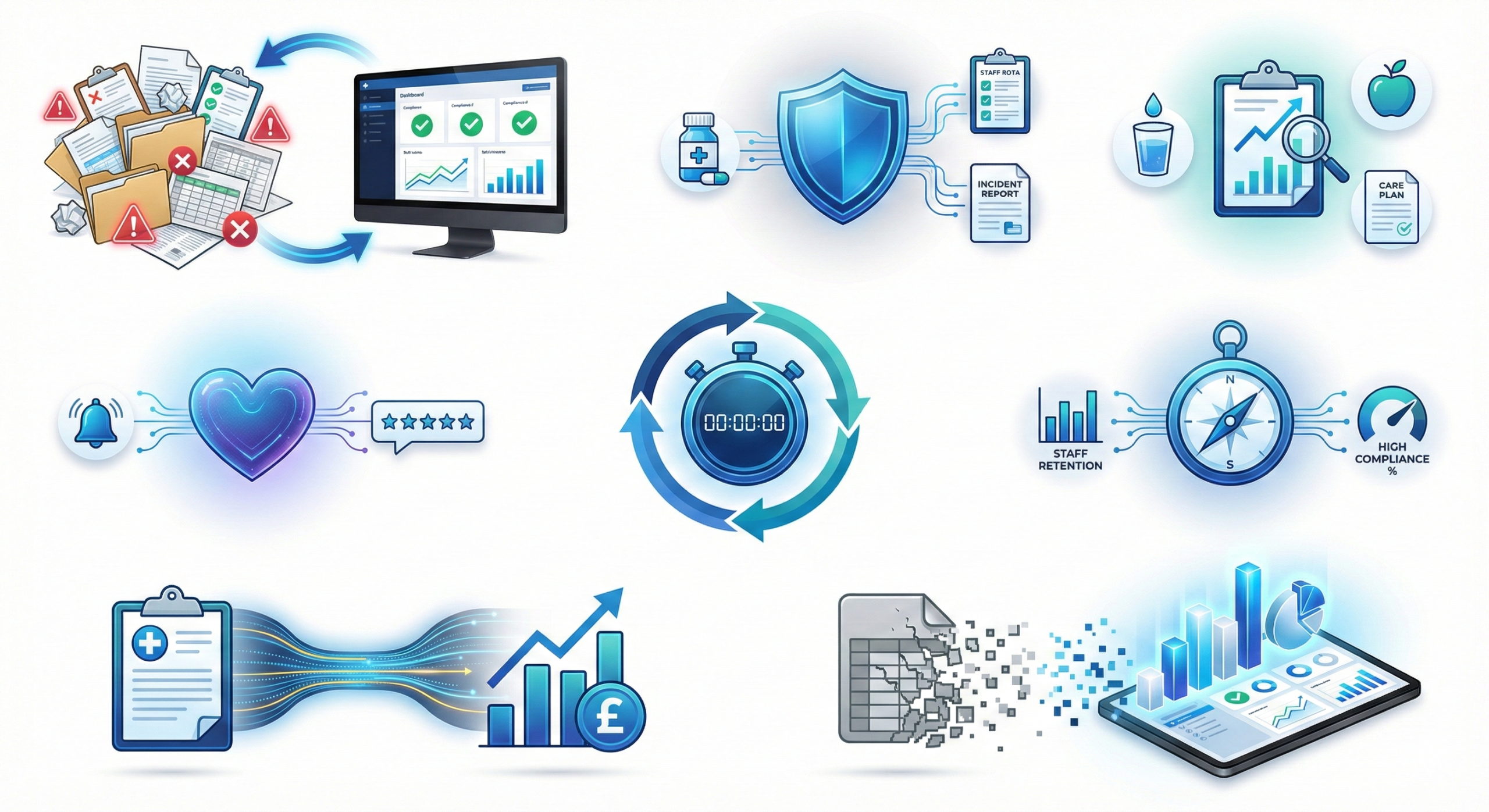
When CQC inspectors walk through your doors, they are looking for more than smiling staff and clean facilities — they are looking for an audit trail of evidence. Historically, care managers have scrambled to pull this evidence from paper files, disconnected spreadsheets, and fragmented software systems. This manual approach is highly prone to human error and often leaves critical gaps in the data narrative.
Data analytics changes this dynamic entirely. Instead of reacting to an inspection, data-driven care homes are continuously inspection-ready. Real-time data allows managers to instantly generate reports proving that care standards are consistently met across all shifts and departments.
How does evidence availability reduce compliance risks?
Without centralised data, you cannot spot negative trends before they become compliance failures. For example, if you cannot instantly see a localised spike in agency staff usage correlating with missed care logs, you are operating blindly.
Care providers using integrated analytics spend significantly less time preparing for audits and face fewer regulatory warnings. By transitioning to automated dashboards, care leaders can spend less time wrestling with data and more time acting on it.
If your care home is still relying on manual processes to prepare for inspections, our Power BI consultancy team can help you build the reporting infrastructure to change that — without replacing the systems you already use.
What should care homes do before a CQC inspection?
Preparation is everything. The care homes that perform best during CQC inspections are those that treat every week as if an inspector might arrive on Monday morning. This mindset shift is only possible when your data is always current, always accurate, and always accessible.
There are three practical steps any UK registered care provider can take right now. First, centralise your incident and accident logs into a single digital system — even a structured spreadsheet is better than paper files scattered across departments. Second, ensure your training matrix is live and updated weekly, not quarterly. Expired mandatory training is one of the most common triggers for a “Requires Improvement” rating. Third, track your occupancy and staffing ratios daily — inspectors scrutinise these numbers closely because they directly indicate whether residents are receiving adequate care.
Once these three foundations are in place, the next step is consolidating them into a single dashboard view. When an inspector asks “can you show me your incident trend over the past six months?”, the answer should take seconds — not hours of spreadsheet searching.
At Quematics, we work with UK registered care providers to build exactly this kind of care home analytics infrastructure — starting with the data you already have, and building toward a fully automated, inspection-ready reporting model using Microsoft Power BI.
For further guidance on CQC inspection standards, visit the official CQC guidance for residential adult social care providers and the Skills for Care workforce development resources.
Frequently asked questions
What is the biggest data challenge during CQC inspections?
The inability to quickly produce accurate, cross-referenced evidence from multiple departments — for example, matching staff rotas to incident reports.
Can analytics predict CQC ratings?
While not a guarantee, robust analytics can highlight the exact operational gaps that lead to “Requires Improvement” ratings, allowing for proactive remediation before an inspection.
Are spreadsheets enough for CQC compliance?
For very small homes, possibly — but as operations grow, spreadsheets become fragile, siloed, and lack the real-time visibility that modern inspectors expect to see.
How do we start digitalising our evidence?
Start by identifying your most critical missing data point — often incident tracking or staff compliance — and build a dashboard to automate that specific area first.