
Series 1, Article 4 of 8 — Charity Data Analytics for ICB Commissioners
What is charity impact measurement and why do ICBs need more than activity data?
Charity impact measurement for ICB evidence is the process of demonstrating the system-level value your service creates — going beyond contact counts and PROM scores to show what your intervention prevents, delays, or avoids within the wider health and care economy. ICBs commissioning under the 2026 NHS Strategic Commissioning Framework are accountable for population health outcomes across their entire footprint. They need VCSE partners who can articulate how their service contributes to system-level goals — not just report their own activity in isolation.
This is Article 4 of our eight-part series on charity data analytics for ICB commissioners. Previous articles covered performance KPIs, productivity analytics, and outcomes and PROMs.
What does system-level impact evidence look like for a health charity?
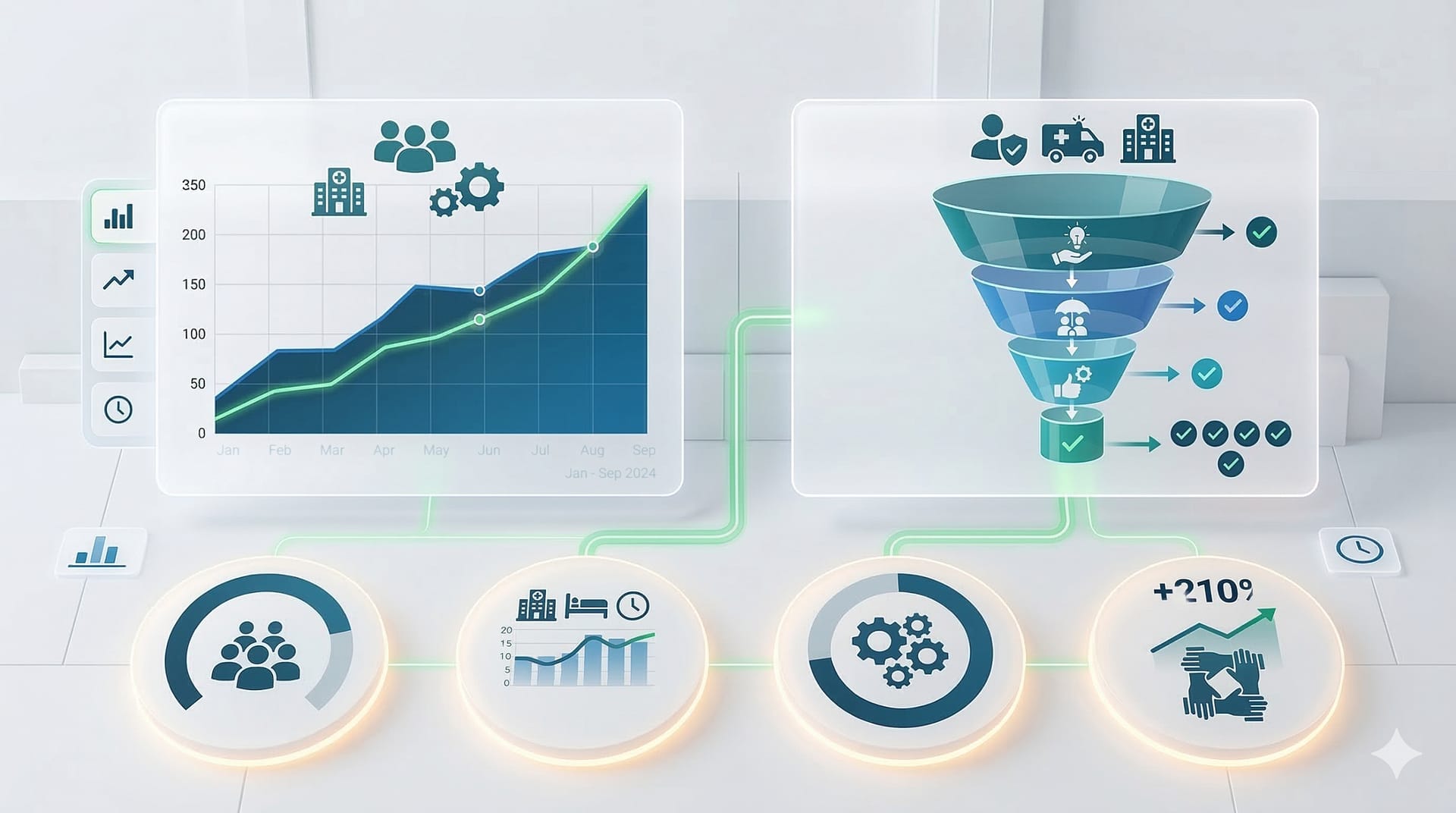
System-level impact evidence connects what happens inside your service to what happens in the wider health system as a result. The most powerful impact indicators fall into four categories.
Avoided escalation evidence is the most compelling impact metric for commissioners focused on secondary care pressures. If your service intervenes early and prevents service users from reaching the threshold for CAMHS referral, inpatient admission, or A&E attendance, that prevention has a quantifiable system value. Tracking the percentage of service users who do not step up to higher-intensity services — and comparing this against population benchmarks — creates a proxy measure of avoided escalation that commissioners find highly persuasive.
Timeliness improvement evidence shows whether your service is reducing the time between a person identifying a need and receiving appropriate support. Comparing median waiting times before and after service changes, or against sector benchmarks, demonstrates a concrete improvement in access that reduces the risk of deterioration during the wait.
Backlog reduction evidence demonstrates operational improvement over time. A waitlist trend chart showing a reducing backlog following a service change or additional resource investment gives commissioners confidence that problems are identified and addressed — not simply inherited from one year to the next.
Service improvement effects connect your quality improvement activities to measurable KPI changes. When you implement a new triage process, change your DNA management approach, or introduce a new group therapy programme, the impact on your performance and outcomes KPIs should be visible in the data. Commissioners want to see evidence of a learning organisation — one that uses data to improve, not just to report.
How do you build a commissioner-ready impact narrative?
The most effective impact presentations combine three to five headline statistics with specific case examples that bring the numbers to life. A standalone statistic — “73% of service users showed clinically significant improvement” — is useful but impersonal. A case study that describes a specific service user’s journey, supported by data showing their EDE-Q score change and the reduction in GP contacts that followed, creates an impact narrative that is both emotionally compelling and evidentially robust.
This is the qual-plus-quant synthesis we discussed in our article on securing your charity’s future under the 2026 ICB implementation programme. Qualitative case studies without supporting data are increasingly insufficient. Quantitative data without human narrative fails to communicate why the numbers matter.
Building this evidence base requires a structured case tracking system that connects individual service user journeys to aggregate outcome data — something a well-configured Power BI impact dashboard can maintain automatically, eliminating the annual scramble to compile impact report evidence before a funding deadline.
What data infrastructure does a health charity need to evidence system impact?
To build credible avoided escalation evidence, you need onward referral data — specifically, destination and reason for every step-up referral made from your service. To build timeliness evidence, you need consistent waiting time data across your full referral history. To build backlog reduction evidence, you need a monthly snapshot of your open waitlist count going back at least twelve months.
Most charities hold fragments of this data across multiple systems. The Quematics approach is to connect these data sources into a unified charity analytics platform that produces impact evidence automatically, without requiring clinical staff to compile reports manually.
Frequently asked questions
What is avoided escalation and how do you measure it for an ICB commissioner?
Avoided escalation is a proxy measure of the number of service users who did not progress to a higher-intensity or more expensive care pathway as a result of your intervention. It is measured by tracking the percentage of service users who close without a step-up referral, compared against sector benchmarks or historical rates before your service was in place.
How many commissioner-ready case studies should a health charity produce per quarter?
Two to three well-documented case studies per quarter — each with supporting outcome data — is generally sufficient for commissioner reporting purposes. Quality matters far more than quantity.
Can partner organisations contribute to a charity’s impact evidence?
Yes — shared intelligence from partner organisations, such as GP practices confirming reduced consultation frequency for referred patients, adds a cross-system dimension to your impact evidence that is difficult for commissioners to dismiss.
Is qualitative feedback sufficient for ICB impact reporting?
No longer. Under the 2026 framework, qualitative feedback must be paired with quantitative evidence. Collecting and coding service user feedback thematically — so you can report the top three impact themes and the percentage of respondents citing each — transforms qualitative data into a format commissioners can engage with analytically.
Need Commissioner-Ready Reports Your Funders Will Trust?

Mohsin Farhat
AI & Data Analytics Leader | 15+ years in Data Analytics, Automation & Decision Intelligence | Healthcare • NHS • Public & Private Sector
Connect on LinkedIn


