
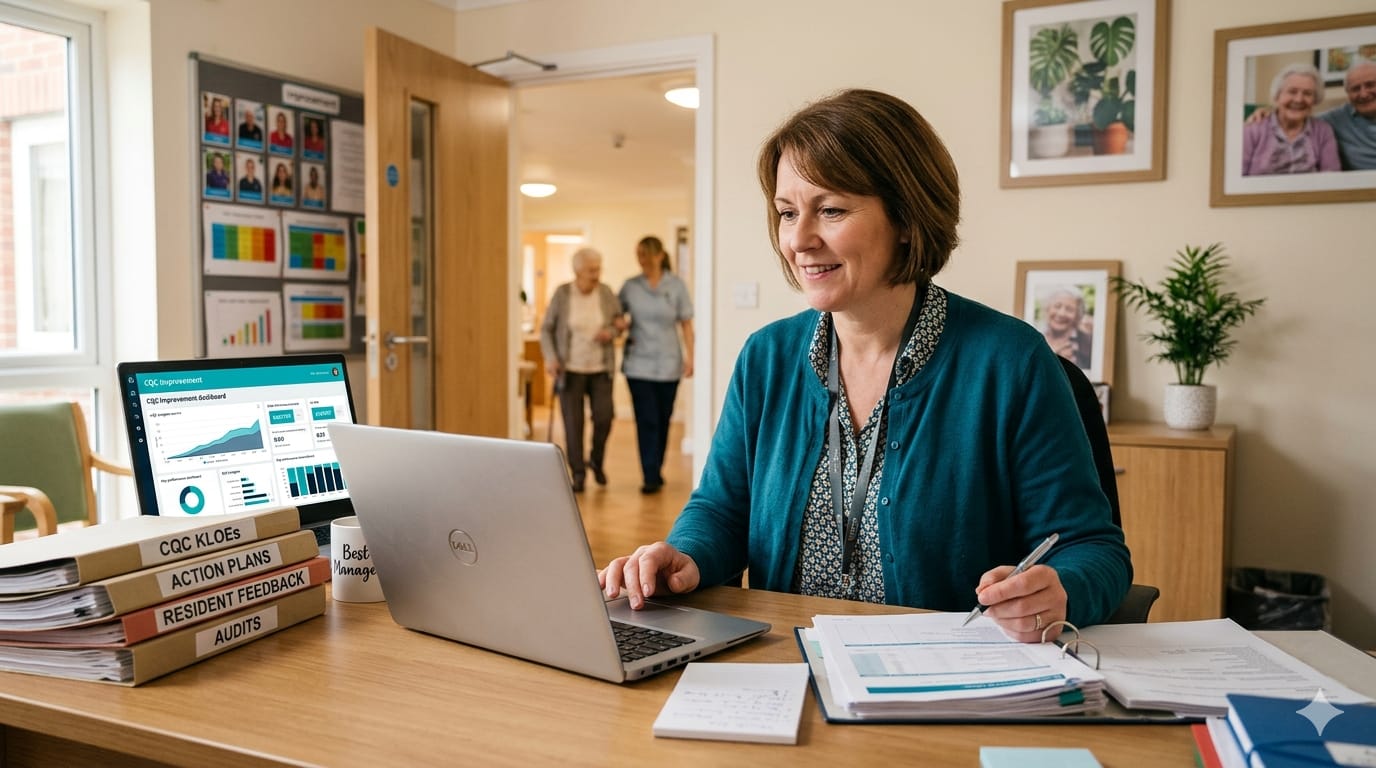
CQC compliance dashboards are live Power BI reporting environments that track a care home’s performance against the Care Quality Commission’s five key questions — Safe, Effective, Caring, Responsive, and Well-Led — in real time. Quematics builds CQC compliance dashboards specifically for UK registered care providers, connecting existing care management systems to automated inspection-readiness reporting without replacing any software or adding data entry for frontline staff.
In England, over 15,000 registered adult social care locations are subject to CQC inspection under the Single Assessment Framework introduced in 2024. Care homes rated Requires Improvement account for approximately 18% of all registered locations, and a significant proportion of those ratings originate in the Safe and Well-Led domains — precisely the areas where data-driven oversight makes the most measurable difference.
What does a CQC compliance dashboard track?
A well-built CQC compliance dashboard consolidates data from across the care home’s operational systems into a single reporting environment. Rather than checking individual care records, incident logs, HR systems, and audit spreadsheets separately, the registered manager sees a live summary of performance across every CQC domain.
For the Safe domain, the dashboard tracks incident rates and trends, safeguarding referral status, medicines administration compliance including MAR chart completion rates, and Deprivation of Liberty Safeguards (DoLS) authorisation expiry dates. For the Effective domain, it monitors care plan review currency — showing exactly which residents have overdue reviews — and tracks outcome measures such as MUST nutritional scores, Waterlow pressure area assessments, and weight change percentages across the resident population.
The Caring domain is evidenced through resident and family feedback trends, complaint resolution times, and engagement activity rates. Responsive is tracked via admission and discharge flow, waiting times, and personalisation indicators. Well-Led — the domain most frequently cited in regulatory action — is demonstrated through governance meeting frequency, open action completion rates, quality improvement plan progress, and training compliance across the workforce.
How does a CQC dashboard help during inspection?
CQC inspectors applying the Single Assessment Framework follow the golden thread — the connected chain of evidence from individual resident care through to provider-level governance. A live CQC compliance dashboard creates this thread automatically by linking individual care records to service-level metrics to governance reporting in a single, timestamped audit trail.
When an inspector asks “how do you have oversight of medicines management?”, a registered manager with a CQC compliance dashboard can show 12 months of MAR chart completion rates, flagged errors with investigation records, and trend analysis — all generated automatically from the care management system. This is fundamentally different from producing a manual audit folder assembled in the days before inspection.
According to CQC’s own published methodology, the most common evidence gaps that lead to Requires Improvement ratings include inconsistent quality monitoring, insufficient governance oversight, and inability to demonstrate learning from incidents. A compliance dashboard addresses all three by making oversight continuous rather than periodic.
Which care management systems connect to a CQC dashboard?
Quematics connects CQC compliance dashboards to the care management systems UK care homes already use. This includes Nourish, Person Centred Software (PCS), CareDocs, Care Control, and Log my Care. For workforce data, connections include Rotaready, RotaCloud, Care Hires, People HR, and Excel-based rota systems. Financial data from Xero, Sage, and management accounts spreadsheets can also be incorporated.
The connection method depends on the system — some support direct API integration, others use scheduled data exports. A data audit at the start of every Quematics engagement identifies the most reliable connection approach for each system in the care home’s specific technology stack.
Who benefits from CQC compliance dashboards?
Registered managers use the dashboard daily — checking for overdue care plan reviews, flagged incidents, staffing gaps, and any metric that has moved outside its expected range. Nominated individuals and responsible persons use governance views for monthly quality reports without requiring manual data extraction. Multi-site operators use benchmarking across homes to identify which locations need targeted support before problems escalate to regulatory concern.
Care homes currently rated Requires Improvement or Inadequate benefit most immediately — a CQC compliance dashboard provides the ongoing, dated evidence of improvement that inspectors look for at reinspection. Homes rated Good use dashboards to protect their rating and build the evidence base for an Outstanding assessment.
How Quematics builds your CQC compliance dashboard
Every engagement follows a structured three-phase process. Phase one is a data audit — we identify every data source the care home holds, assess quality and completeness, and map each CQC domain to the specific metrics your data can support. Phase two is the dashboard build — Power BI connects to your systems and the dashboard is configured with the metrics, thresholds, and alert rules agreed during the audit. Phase three is user acceptance and training — registered managers and governance leads are trained on interpretation and daily use.
Typical implementation takes four to six weeks from data audit to live dashboard. Multi-site deployments with additional benchmarking requirements may take eight to ten weeks.
Quematics is a UK-based Power BI consultancy specialising in care home analytics and charity analytics. We are based in Peterborough, serving care providers across England.
Frequently asked questions
What is a CQC compliance dashboard and how does it work?
A CQC compliance dashboard is a live Power BI reporting environment that connects to a care home’s existing data systems and displays real-time metrics across all five CQC domains — Safe, Effective, Caring, Responsive, and Well-Led. It replaces manual audit processes with automated, continuous monitoring.
Which CQC domains can be tracked with Power BI?
All five CQC domains can be tracked. Safe domain metrics include incident rates, MAR chart compliance, and DoLS tracking. Effective covers care plan review currency and outcome measures. Caring tracks feedback and engagement. Responsive monitors admissions flow. Well-Led evidences governance and improvement plan progress.
How does a CQC dashboard help during inspection?
CQC inspectors follow the golden thread from individual care to governance. A compliance dashboard creates this thread automatically, providing 12 months of dated, timestamped evidence that demonstrates continuous oversight.
What care management systems connect to a CQC dashboard?
Quematics connects to Nourish, Person Centred Software, CareDocs, Care Control, Log my Care, and Excel-based systems. Workforce connections include Rotaready, RotaCloud, and People HR. Financial data from Xero and Sage is also supported.
How long does it take to implement a CQC compliance dashboard?
Typical implementation takes four to six weeks for a single care home. Multi-site deployments take eight to ten weeks.
Can a CQC dashboard help a Requires Improvement home move to Good?
Yes. A CQC compliance dashboard provides the ongoing, dated evidence of improvement that inspectors look for at reinspection. Homes implementing analytics-supported improvement programmes are consistently better positioned at reinspection than those relying on policy changes alone.
Ready to build your CQC compliance dashboard?
Book a free CQC dashboard review with Quematics. We will assess your current data systems, identify the CQC domains your data can evidence, and show you what a compliance dashboard looks like for your specific care home. Contact us to arrange your review.
For CQC guidance on inspection methodology and the Single Assessment Framework, visit CQC.org.uk.